Fall Plant Swap

Monday, November 20, 2017

Yesterday I went to a plant swap organized by a local nonprofit (thanks Brave Harvest). Everyone brought potted plants or cuttings to trade, and the organizer provided pots, potting soil, and rooting hormone. I wish I had taken more photos of the event in action, but honestly I was having too much fun geeking out with other people who love plants as much as I do.

Here's a pic of my new babies. I decided to keep put them in my bathroom so that I can keep an eye on them. This spot is more protected from my dogs and kids, and it's the most humid environment I have in my home.

I got cuttings of two different cassias -- one with large leaves (Cassia alata) and one with small leaves (Cassia bicapsularis). I cut back the foliage on the larger cassia after this photo was taken, to help prevent it from drying out before it forms good roots. I also snagged Lady Margaret passion flower (Passiflora x Lady Margaret) and Turk's cap (Malvaviscus pendiflorus), all of these from the same generous gardener. My friend Erin also gave me a small, spiky, vase-shaped aloe and some twee  succulents that remind me of little tongues (or even lateral lithops, given the patterning). She said they're some type of Gasteria spp.

Cross your fingers that these babies all make it!

(The little plant on the windowsill is a


I'm back!

Thursday, August 24, 2017

I'm back! Yes this blog has been dormant for awhile, but I'm finally tinkering in the yard again so I thought I may as well document what I'm planning and planting.

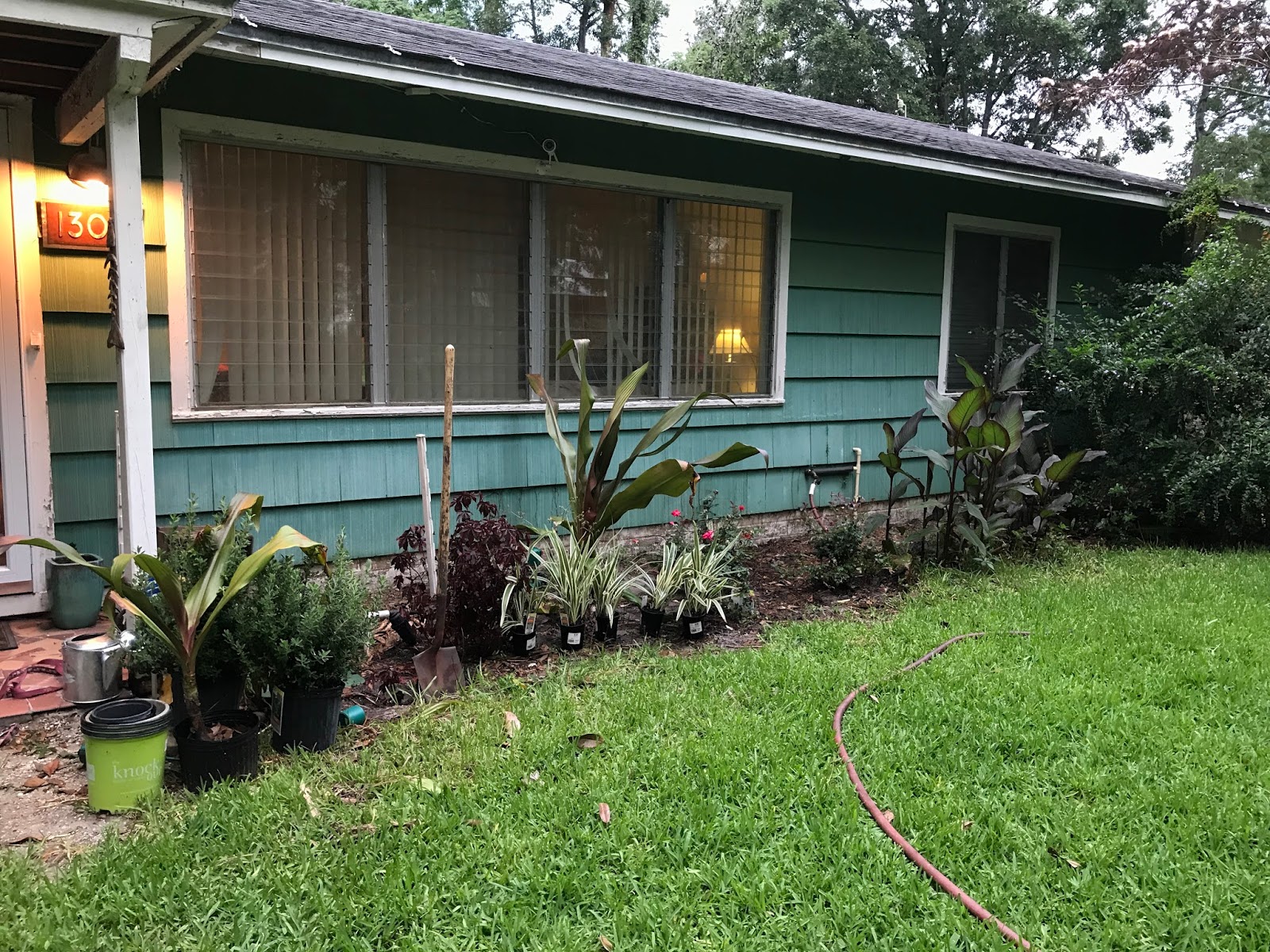
For  my birthday this year I treated myself to a number of plants destined for the foundation bed in the front yard -- knockout roses, Texas sage, flax lily, and a variegated lemon tree. The lemon tree went in a different bed though.


This picture was taken earlier this summer. And then it rained basically non-stop. Seriously. This was the wettest summer on record here in Gainesville. So now my grass is brown, not green, because all this moisture seems to have created the perfect conditions for some sort of lawn disease to creep in and take hold. I'm guessing it's fungal. But that's another post for another time.

Make it rain, or how to install your own DIY irrigation system

Saturday, July 16, 2011

Despite how hideous our lawn has been looking, my husband wisely pointed out that we probably aren't ready to install new sod yet. He reminded me that we're missing something really important: a reliable way to irrigate new sod.

I pointed out that we have a functional sprinkler and a long hose. He said I was crazy.

Okay, not really. But he did say that there was no way he was going to drag a hose around the yard for weeks and weeks to make sure that the new sod wouldn't fry in our hot Florida summers. I had to admit -- he had a valid point.

So we decided to spend our Independence Day weekend installing a proper irrigation system.


All in all, I think we dug at least 130 linear feet of trench. Since our soil is so sandy, it was relatively easy to get the trenches dug. I say "relatively" because it's still a lot of heavy lifting compared to the desk jockey stuff I do on a day-to-day basis. If we were going to do it again, I might want to rent a trencher. Of course, that requires advance planning, and we didn't decide that we were embarking on this project until sometime on Saturday.

On the positive side, we did have a few extra bodies who stopped by while we were digging trenches.


Our dogs love spending time with us when we're working in the yard, and being the softies we are, we let them. The black one is hilarious -- any time we dig a hole, he always starts rooting around in the soil like a pig hunting for truffles. Here he is sniffing the soil and digging deeper. If only we could train him to dig in a controlled fashion!


It took awhile, but ultimately we got all of the trenches dug and all of the pipes and irrigation heads laid out and glued together. We opted for overhead spray heads rather than drip emitters, since those are the best option for irrigating lawn areas. We even installed a timer and a rain sensor so that the system will run only when the lawn needs water.

Here's the finished project, with the soil tamped back in place. Now we just need sod!


Would I do it again? Absolutely. It was a lot of work but it saved us a ton of money to do it ourselves. Our cost for materials was about $300, whereas we would've paid a professional upwards of $1,000 to do the same job. Plus we ended up with a huge feeling of satisfaction, which is priceless.

For anyone who's interested, here's a fun time lapse video that we took on the second day of the project.


Lush lawns: the must-have accessory for bold gardens

Friday, July 15, 2011

Good-ness! It's been awhile since I posted. Here's the quick update on the seedlings. A good number of them survived, despite the fact that I neglected to transplant most of them out of their six-packs.


These castor beans were a few of the ones that found permanent homes in the yard, and well, now I think they're just showing off to make the others jealous.

It's pretty amazing, really. Some of the plants that were stuck in six-packs were 18" tall and had shoved their little roots out the bottoms of the pots and into the soil below. I'm convinced that the only reason they survived at all was because of the microirrigation system that my husband set up. I seriously love that man.

And speaking of irrigation and why I love my husband, that brings me to my next tale.

For awhile now, we've been making plans to replace our old "mixed" lawn with a new, freshly sodded, beautiful green lawn. My husband is a turfgrass researcher, so it's perhaps not surprising that he wants a nice lawn in front of our house. Of course his specialty is golf courses and athletic fields, so I'm pretty confident he'll never turn into one of those crazy lawn-obsessed men who you see weeding their yard with tweezers every Saturday morning!

I've never been the kind of person who felt compelled to have a nice lawn. Mostly it's because I'm lazy busy with other things and don't like the maintenance involved.

That being said, I've come to realize that a good looking lawn can work wonders in a garden. As y'all know, I'm the kind of gardener who likes to mix lots of bold textures and colors in my plant beds. As lovely as that can look, it can sometimes be a little visually overwhelming. That's why you need a quiet place for the eye to rest -- like a lawn.

Lush container at McMayhill & Baker home

DSC_0306

Landscape bed at Bates Garden in Portland

Think of it as the gardening equivalent of a neutral. Having that constant green backdrop will help make your bold and exciting plants really pop.

So we've been trying to kill off what's left of our current lawn. In short, it's ugly. After the winter rye grass petered out, we were left with brown, brown, and more brown. Ugh. I'm somewhat embarrassed about what my garden looks like right now. I know it's temporary, but I still feel like the neighbors probably drive by every day and wonder what the hell we're up to.

As I said, our plan is to completely re-sod the front yard, but there's something important we had to tackle first. Check back tomorrow for the full post on how we installed our own irrigation system!

Seedling update

Friday, March 25, 2011

It looks like I'm having better success this year with starting plants from seed. Here are two shots of the first few plants popping their heads above the soil line.


And here's what they look like now (sorry for the vertical image -- iPhone issues).


What a difference! The only ones yet to sprout are the white datura and green nicotiana. I owe my hubby a big thanks for setting up the microirrigation system. Without that, I'm not sure the plant babies would've stood a chance.

Looks like I'll either have up-pot these or transplant them pretty soon here, before they get too big for those little cell packs.

- Posted using BlogPress from my iPhone

Lovely spring

Thursday, March 24, 2011

We have had one of the loveliest springs that I've ever seen. I guess it's because we had a consistent stretch of consistent cold and then a gradual warming up, rather than the cold/hot/cold that we've had in other years.

The fragrance coming from the orange blossoms has been off the charts. I wish that this picture could be scratch and sniff so that you could smell the flowers firsthand!


All of the flowering trees and shrubs are blooming their hearts out. I just adore this Chionanthus virginicus outside my husband's office.


And now the herbaceous plants are revving up to bloom. Here's one of the soap aloes that we planted last spring along the street.


For those of you living farther north, hang in there -- hopefully spring won't be too far off!

- Posted using BlogPress from my iPhone

So far so good

Wednesday, March 2, 2011

I decided to start some seeds this year. I figured I had little to lose since I already had a bunch of seeds hanging around from my last attempt.


So far they're looking good! I planted them last week and already the zinnias and roselle are popping up.

I think a big help is that my wonderful husband set up a timed microirrigation system to help keep them moist. That's really what I had problems with the last time. The seeds came up on their own, but I think they dried out before I got them planted in the ground.

Who knows--maybe this year I'll break the seed-starting curse!

- Posted using BlogPress from my iPhone

Snail orgy

Saturday, February 26, 2011

One of my succulents has been looking pretty shabby for awhile now. I figured it was probably the result of cold damage.


But today I hatched another theory.


Do you see these? ALL of these snails came out of that one pot, and I'm guessing there were probably more that I missed.

As angry as I was at them for ruining my pretty plant, I just couldn't bring myself to destroy them. Something about the sound of the shells crunching seemed like it would be akin to nails on a chalkboard.

Instead I opted for the "catch and release" method, flinging them into one of the wilder corners of the yard. Hopefully they'll stay there.

- Posted using BlogPress from my iPhone

Spring!

Thursday, February 17, 2011

It's official! Spring has sprung in our yard. So far, the camellias are in bloom...


...and the Japanese magnolia has also mustered a few blossoms, despite the fact that the squirrels have been treating it as an all-you-can-eat buffet.


Best of all, our lawn is still a lush green since my sweet hubby overseeded with rye. It's funny--for once we have a green lawn with brown plants instead of the other way round!


I know most of you are still trapped under a blanket of snow and that spring is still weeks (or months) away. Just think of it this way--you still have oodles of time to look at seed catalogs and plan your garden.

I'm realizing that if I want to start any seeds, I'd better not wait much longer. Maybe I'll try starting some cardoon again since I still have some of those seeds, and definitely some tomatoes. We'll see!

- Posted using BlogPress from my iPhone

Small is powerful

Thursday, October 14, 2010

The last few days I've been reminded that small doesn't always mean insignificant. In fact, small can be quite powerful.


The fragrant olive bush (Osmanthus fragrans)in our backyard just started blooming. Even though each flower is no bigger than a pencil eraser, they all pump out an amazing amount of fragrance.

Case in point: every time I step out the door, I can smell the flowers. Nevermind the fact that the shrub is at least 40 feet away.

In fact, this shrub is a big part of why I fell in love with the backyard and bought the house. Well, the shrub and also the orange tree, but that's another story for another time.

At any rate, every time I smell these tiny flowers I'm reminded of an old saying:

"If you think you are too small to be effective, you have never been in the dark with a mosquito."


Ain't that the truth!


No orange meatballs

Wednesday, October 13, 2010

Fall has finally arrived here in North Florida. The mornings and evenings are noticeably cooler, the sun is dipping lower in the horizon, and it seems like everyone is plopping potted mums by their front doors.


Don't get me wrong--chrysanthemums aren't bad plants. I even like spider mums a little bit. But the orange and yellow meatball-shaped mums are sooooo overdone.

This fall, why not think outside the usual plant palette? Choose plants that have warm colors like yellow, orange, or even purple, but avoid making any stereotypical plant choices like mums. Trust me. Your neighbors will thank you.


Canna damage

Friday, August 20, 2010


Canna damage
Originally uploaded by sassycrafter
The other day, I noticed a lot of damage on this canna. I figured I'd better take a look at the plant and see what was going on. After a brief scouting session, I found a hungry larger canna leaf roller that was treating my beloved canna like his own personal all-you-can-eat buffet. This was definitely not cool in my book, since this was the Canna 'Intrigue' that I paid good money for on my trip to Plant Delights Nursery.

If you live in Florida and don't know about canna leaf rollers, then it's time you learned. Most of the people I work with here at UF/IFAS would probably agree that leaf rollers are the most troublesome canna pests in our state. In fact, all of the damage that I found on my plant seemed to be the result of a single critter. Sure, it took me a few days between when I noticed the problem and when I checked it out. But still -- that's a lot of damage for just one caterpillar.
Larger canna leaf roller (UF/IFAS)

The lesser canna leaf roller can be a little harder to discover. These caterpillars are much smaller and typically roll themselves up in the edge of a leaf, where they then feed only on the top layer of the leaf.

Lesser canna leaf roller (UF/IFAS)
So if you have cannas in your yard, be sure to scout for pests often. It's a snap to make your own scouting kit, and it's much easier to get a problem under control if you find it early. You can hand pick the pests if there's just a few of them, or treat the plant with a biorational insecticide like Bt (Bacillus thuringiensis) that kills the caterpillars without harming beneficial insects.

Needless to say, that leaf roller won't be bothering my plants again.

Dreaming of a cooler time--Pacific Northwest, Part III

Monday, August 2, 2010

It's officially hot. Temperatures have been in the mid-90s or higher for days now, and the heat index has gotten as high as 105. Both me and my poor plants feel like we're melting, so I figured now was as good a time as any to put up those final photos from my spring trip to the Pacific Northwest.

After we left Seattle, we were destined for Victoria, BC. We drove to Post Angeles and then took the ferry across the Straits of Juan de Fuca.


The weather was pretty amazing while we were in Victoria, BC -- not too hot and not too cold. We poked around the town area for a day or two, and then headed to our ultimate destination -- the world-famous Butchart Gardens. The place was pretty surreal -- kind of like Walt Disney World for gardeners.

Here's the shot that everyone takes when they visit Butchart -- the view from the staircase at the top of the sunken garden. There's a really cool story behind this garden.

Sunken garden at Butchart Gardens in Victoria, BC

It was a little overcast during part of the day, but the place was still non-stop, in-your-face texture and color.

Amazing orange tulips at Butchart Gardens

Yellow and green tulips at Butchart Gardens

See what I mean? Those tulips were insane! I swear that I didn't Photoshop these shots to enhance the color. And speaking of tulips, I couldn't believe how well our shirts matched the tulips in this shot. Crazy, eh?

Butchart Gardens in Victoria, BC

It seemed like everything was bigger and better at Butchart. Get a load of this arborvitae hedge -- it has to be one of the hugest hedges I've ever seen. Jason is just barely visible at the base of the hedge, even though he's over 6 feet tall. If you're trying to create privacy in your yard, this is definitely the way to do it!

Huge arborvitae hedge at Butchart Gardens in Victoria, BC

On a smaller scale, I thought this was a clever and inexpensive way to create a visual barrier between a path and a lawn area. I guess if you have close to a million visitors each year, it's important to keep them off of the lawn.

Split bamboo edging at Butchart Gardens in Victoria, BC

And I know this shot doesn't look like much, but I had to share it. Those little stumps in the right side of the frame are bananas! Yes! Bananas in Canada! My guess is that they have to cut them to the ground each fall and protect them with straw, but they might be left to fend on their own. I'm guessing they're Musa basjoo.

Bananas in Butchart Gardens in Victoria, BC

Well, that's about it for Butchart. I guess now it's time for me to brave the heat and turn over a new leaf, pulling out the melted plants in my yard. Ugh. Wish me luck!

Sunken garden at Butchart Gardens in Victoria, BC

Plant death tolls

Tuesday, July 27, 2010

So the ensete is still hanging on. I wish that it looked as good as this one that I saw at Plant Delights Nursery last year, but ultimately I think its days are probably numbered. I think I'll probably have to add it to the tally of "plants I've killed" before summer is over.

But thanks to the Plant Delights Nursery E-newsletter that I received today, I don't feel quite so bad about it. Apparently, Tony Avent and his esteemed colleagues have killed their fair share of plants too. Here's what he recently wrote:


"Here at PDN, we’ve celebrated a milestone recently, as our database indicates that we have now passed the 20,000 mark for killing plants. 20,194 dead accessions (different plants) is actually our current total, so don’t even think about complaining that you have a brown thumb. Our dead/alive plant rate now stands around 50%, but since our goal is trialing, experimenting, and learning the possible parameters under which each plant will grow, these numbers are actually a good thing...I’m constantly reminded of the late Dr. J.C. Raulston’s quote, 'If you’re not killing plants, you’re not growing as a gardener.' No truer words were ever spoken."


Amen! This makes me feel at least a little bit better that my beautiful ensete may ultimately wind up in the compost pile. At least I'm only in double digits of plants that I've killed. That five-figure mark is a completely different league.

If you'd like to hear Tony's pearls of wisdom firsthand, subscribe to the PDN newsletter here.

Ensete death march

Friday, June 18, 2010


Sick ensete
Originally uploaded by sassycrafter
Well, it looks like I was right. My beautiful ensete is dying. This is what it looked like after I came home from my out-of-town conference this week. Definitely not good.

I just wish I knew what was going on with it and if there was any way to save it. I'm wondering if nematodes might be the culprit, since they're mentioned in this article. If that's the case, I'm thinking that my best bet would be to get a nematode assay done before I plant another ensete in the same spot.

Front garden progress

Wednesday, June 16, 2010

Earlier this week I blogged about the potentially sick ensete. I figured I might as well share some photos of the other beautiful things that have been going on in the front garden.

First off, the cannas and bananas have been going gangbusters. The 'Red Stripe' canna that I bought at Plant Delights Nursery last September is getting huge, and the 'Intrigue' canna is looking beautiful. The striped canna is 'Bengal Tiger'. It was a generous passalong plant from Tom, along with a dwarf Cavendish banana that's doing splendidly.

Speaking of what I bought at PDN, the chasmanthium seems to have died. Very sad. It turned brown over the winter and I cut it down in spring. It put out a half-inch or so of new growth but then never grew any more. In Southernese, I'd say it up and died.

But back to the pretty stuff. Here are some macro shots of the cannas and bananas for you to salivate over.

Canna indica 'Red Stripe'

Canna indica 'Red Stripe'

Canna 'Bengal Tiger'

Canna 'Bengal Tiger'

Canna 'Intrigue'

Canna 'Intrigue'

Musa acuminata 'Dwarf Cavendish'

Dwarf Cavendish banana

And one of the mystery cannas that we transplanted recently is about to bloom. I'm wondering if it might also be 'Red Stripe'.

Unknown red-flowered canna

Sick ensete?

Sunday, June 13, 2010


Sick ensete?
Originally uploaded by sassycrafter
We planted this beautiful ensete back in April. It's been doing great and has double in height since then. But all of a sudden it's looking a little sick.

It's listing to one side, and the leaves have started wilting. If wilting were the only symptom, I'd wonder if the cause was just the 90+ degree weather we've been having.

Sick ensete?

But the leaves are also looking chlorotic, namely in patches that correspond to where the leaf is sagging.

Sick ensete?

Plus the roots are starting to pop free from the soil, as if they might be decaying.

Sick ensete?

Any ideas what might be going on? I'm wondering if it might be some sort of fungal or bacterial disease. I'd love to be able to treat the problem, but I need to know what's going on before I apply any potential pesticides.

This makes me very sad.

Spring in the Pacific Northwest, Part II

Tuesday, June 1, 2010

Here's the second post about my recent trip to the Pacific Northwest. After spending time in Portland, we made our way up to the Seattle area. Our first stop was in Renton at the Virginia Mason Athletic Center, aka Seattle Seahawks practice facility. As you all know, I'm much more interested in plants than I am in turf, but even I enjoyed this stop.

We got to peek in the indoor practice field which was HUGE. Nike was filming a commercial of some sort while we were there, so we had to sneak in between takes. The outdoor practice fields had a great view of Lake Washington, but it was pretty overcast that day so my pictures aren't that great.


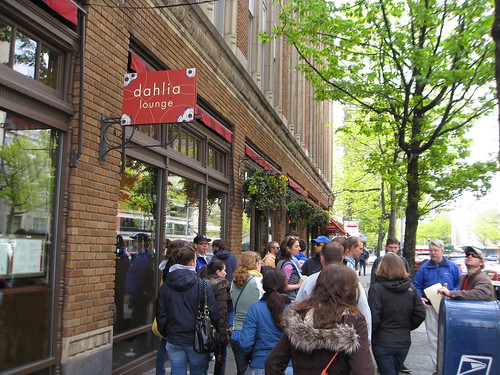
We got back on the bus and headed up to Seattle and met Nolan Rundquist, the city arborist, for a walking tour of the city. It was really interesting to hear about all of the challenges his team faces trying to grow trees in an urban setting. Here's a shot of us on the tour. Of course I just had to put up this particular photo because of the Dahlia Lounge sign, given my love for dahlias.


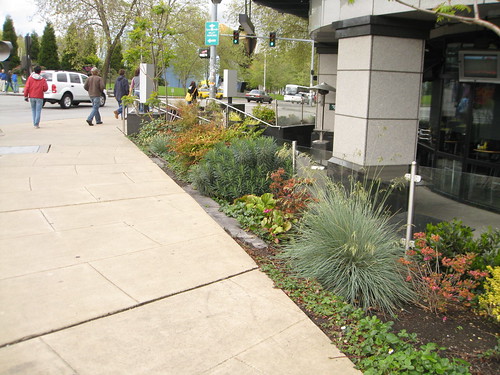
The euphorbias that we saw all over the city were amazing. I wish we could grow these here in Florida, but I've heard that they're prone to powdery mildew.


I really loved the color and texture combinations in this bed.


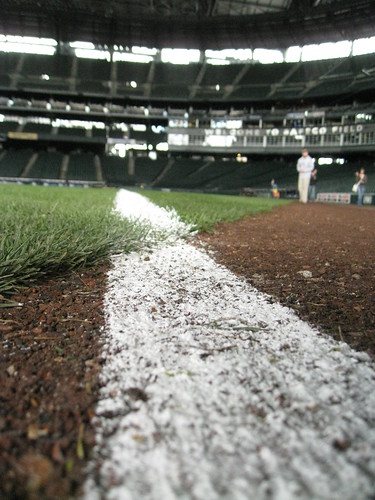
The next day we got a tour of Qwest Field where the Seattle Seahawks play, and a tour Safeco Field where the Seattle Mariners play. I have to say, it was pretty freakin' cool to get to walk on the fields. I mean, how many times do most people get do that? Plus, I've been a big baseball fan since I was a kid, so this was a real treat for me. Here's one of my favorite shots looking down the third base line at Safeco Field.


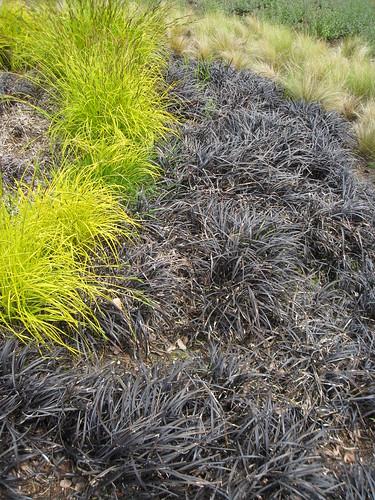
But y'all want to see pictures of plants, right? Fear not! The plant jackpot came when we headed up the road to Bellevue Botanical Garden. It was a delightful garden full of all sorts of fabulous plants in stunning combinations like this one, which I think was a gold sedge and Ophiopogon nigrescens. I'd love to come back and see this garden as it changes from season to season.


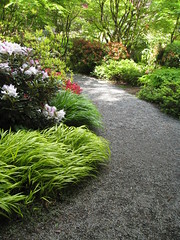
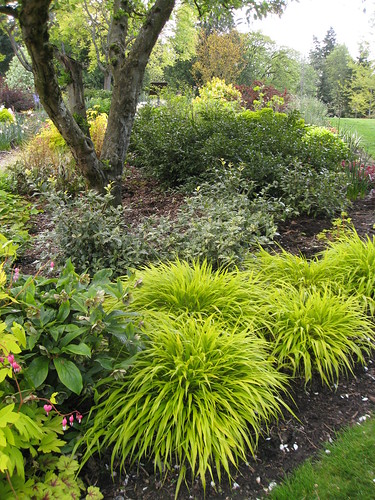
Check out this beautiful Japanese forest grass (likely Hakoenechloa macra 'All Gold'). Isn't it beautiful? Sadly, I've also heard that this one won't thrive here in Florida. Sigh.


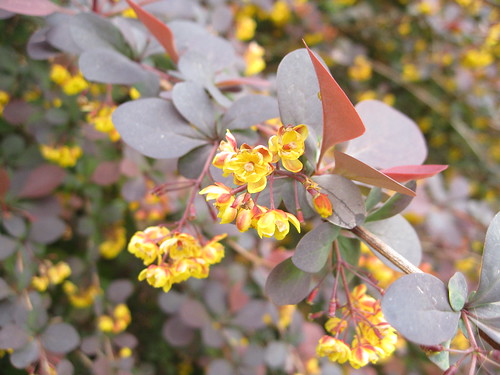
I loved this Cotinus for its striking contrast between the foliage and the flowers. I'm wondering if we can succesfully grow smokebush in Florida. My trusty Southern Living Garden Book says it can be grown as far south as Georgia, but I'm thinking that Florida might be a little too warm for it.


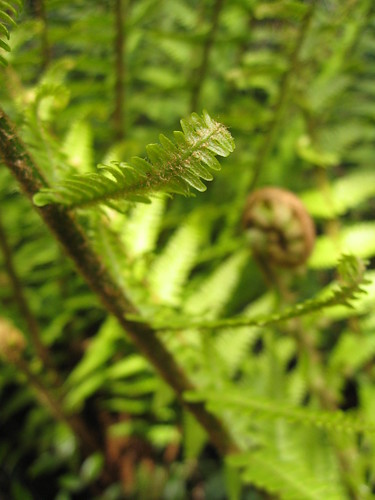
The garden also had tons of ferns, and I've been a sucker for ferns ever since college. They're so primitive and yet so fascinating!


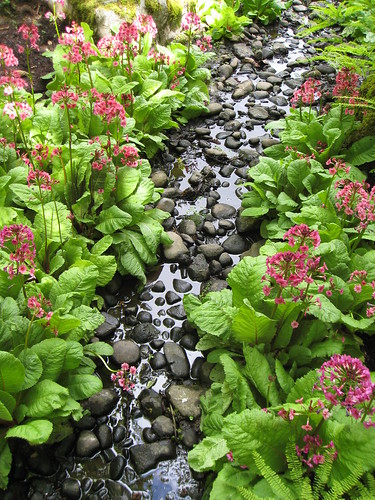
We also saw lots of primroses throughout our journeys in the Pacific Northwest. This was a fairly new plant for me.


Well, that's all for now. The final installment will include the photos I took when we went up to Victoria, British Columbia and visited Butchart Gardens. If you've never seen photos of Butchart, you're in for a treat. I promise the next post will be chock full of bold plant combinations for all of you daring gardeners!